
about profitize
Managing personnel costs in hotels effectively
Why hotels secure their margins through data-based productivity management
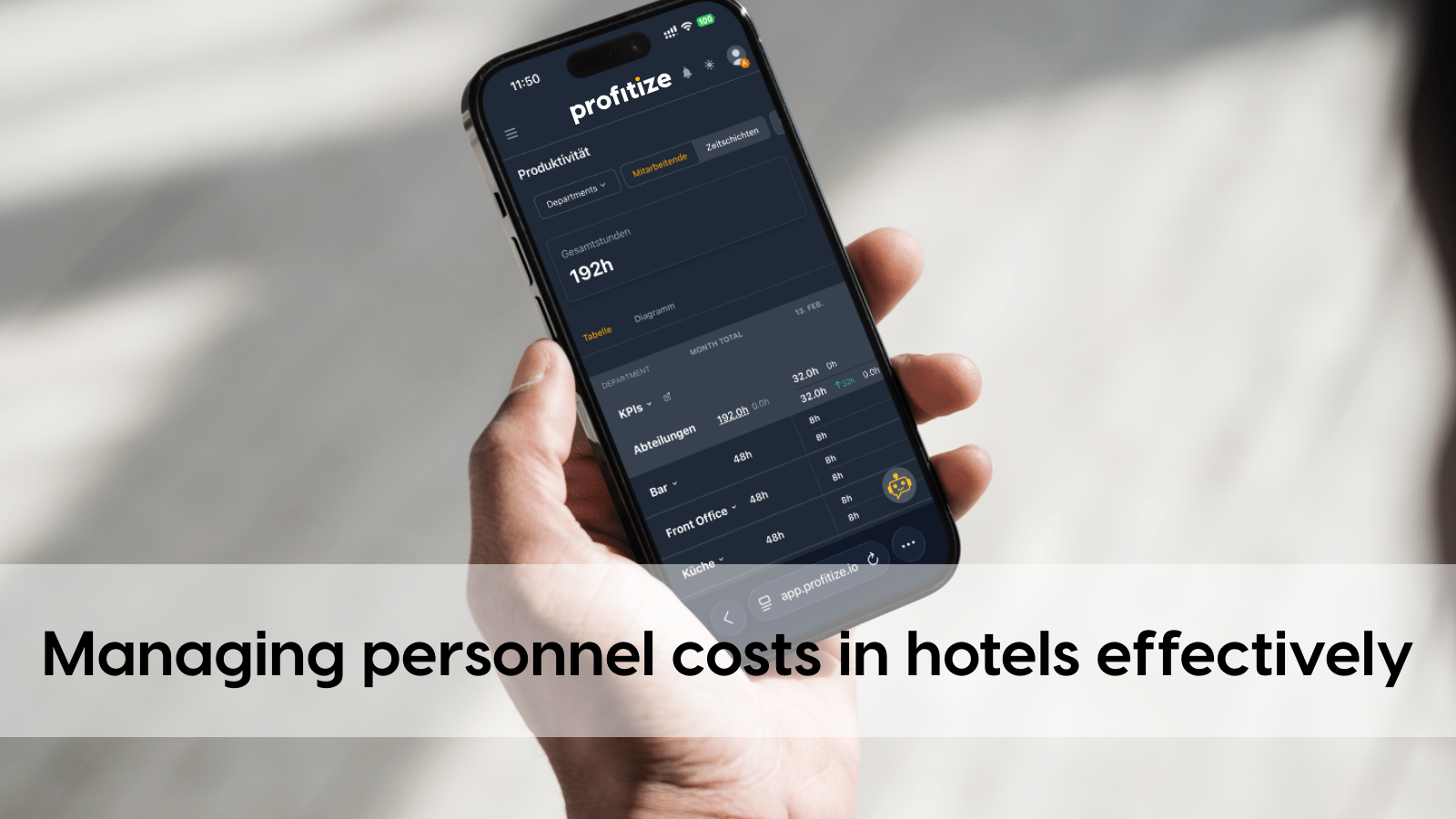
Personnel costs are the largest cost factor in hotels and also one of the most sensitive. Imbalances can quickly arise between forecasts, duty rosters and actual occupancy rates. The profitize productivity tracker systematically links demand and working hours, revealing where hours cost money or secure profits.

When planning fails to cope with reality
Hotels are accustomed to working with forecasts. Occupancy, revenue, pick-up – all of these factors are analysed, evaluated and used strategically.
However, one key question is given less systematic consideration:
Does staffing match expected demand?
In many companies, duty rosters are still based on experience, routine, or previous year's figures. This works as long as demand remains stable. However, in times of short-term bookings, rising wages, and volatile markets, this approach is no longer sufficient.
The effects often only become apparent when the paycheck arrives:
- overtime during busy weeks
- overstaffing during quiet periods
- rising personnel cost ratio despite good capacity utilization
The problem is not a lack of control, but a lack of connection.
Forecasting does not end with sales
A forecast shows how many guests are expected to come.
But it also shows how much operational performance will be generated.
More arrivals mean more room cleaning.
Higher occupancy requires more service staff.
Full breakfast rooms increase staffing requirements in the kitchen and service areas.
Nevertheless, demand forecasts and work schedule planning are still considered separately in many hotels. This is exactly where the profitize productivity tracker comes in.
The feature links forecast data with actual working time information from the HR system. It shows whether planned hours match expected capacity utilization or whether an imbalance is emerging.
If, for example, a busy week is coming up and several employees are absent at the same time, this situation is identified early on. The productivity tracker suggests adjusting shifts or redistributing capacities.
Important to note:
These are not automatic interventions or rigid guidelines. The decision remains with the hotelier. The productivity tracker provides guidance - not instructions.
Practical example: 40 rooms, 10% reduction in personnel costs
An owner-managed hotel with 40 rooms faced a familiar situation: occupancy rates were stable and revenue satisfactory, yet personnel costs were rising steadily. They accounted for around 38% of revenue.
At first glance, everything seemed to be within normal limits. It was only through analysis with the profitize productivity tracker that structural deviations became apparent:
- Housekeeping was overstaffed on slower days
- Service staff regularly worked overtime on peak days
- Vacation planning and seasonal contracts were not aligned with actual demand
Linking forecast and working time data made it clear in which weeks significantly more hours had been planned than would have been economically viable.
Through targeted adjustments, more flexible shift models, more forward-looking vacation planning, and better coordination between departments, the personnel cost ratio fell from 38% to around 34% within a year.
This corresponds to a reduction of around 10%.
With annual sales of €2 million, this means a saving of around €80,000 per year.
Crucially:
It was not about reducing staff numbers, but about more precise management.
Small differences, big impact
In the hotel industry, seemingly small differences quickly add up.
Two additional employees per week working 40 hours each at an average wage of 20 euros per hour result in over 3,000 euros in additional costs per month - that is, more than 36,000 euros per year.
Without structured transparency, such effects often remain undetected.
The profitize productivity tracker analyzes daily data from PMS, HR systems, and financial structures. It recognizes patterns, highlights discrepancies between demand and staffing levels, and helps you take countermeasures at an early stage - before planning errors are reflected in the monthly financial statements.
Productivity means precision fit
Productivity in a hotel does not mean employing as few staff as possible.
It means scheduling staff to match demand.
Those who systematically combine forecasting and working hours come out on top:
- More stable personnel cost ratios
- Less operational hustle
- More planning security for employees
- Clarity for owners and investors
Especially in economically challenging times, this transparency determines the actual profitability of a business.
When planning becomes control
Hotels have learned to manage their prices dynamically.
The next logical development lies in the dynamic management of personnel deployment.
The profitize productivity tracker shows how demand, hourly output, and cost ratio are related. It does not replace the hotelier's decision, but it creates the basis for it.
After all, it is not capacity utilization alone that determines profit,
but rather how precisely hours, service quality, and costs interact.
And that is precisely where sustainable profitability arises.
Weitere Artikel
.png)

.png)
.png)
.png)
.png)
.png)
.png)
.png)

.png)
.png)
%2013.29.32.png)
.png)
.png)
.png)
.png)
.png)
.png)
.png)
.png)
.png)
.png)
.png)
.png)
.png)
.png)
.png)
.png)
.png)
.png)
.png)
.png)
.png)
.png)

.png)
.png)
.png)
.png)
.png)

.png)
.png)
.png)
.png)


.png)
.png)
%20(600%20x%20400%20px).png)
%20(800%20x%20600%20px).png)

.png)


.png)


Oder kontaktieren Sie uns.
Simply contact us via email. We look forward to hearing and reading from you.
hello@profitize.io